If your sustainability team is still wrestling with spreadsheets, PDF invoices, and siloed data systems to compile sustainability metrics, you’re not alone—and you’re wasting critical time and resources.
Nearly 73% of enterprises report that data quality remains their biggest sustainability challenge, according to recent industry surveys. Scattered utility bills, inconsistent emission factors, manual calculation errors, and fragmented data sources create a perfect storm of reporting delays, audit risks, and missed improvement opportunities.
AI sustainability data collection is fundamentally changing how enterprises approach emissions reporting. Instead of months of manual data wrangling, forward-thinking organizations are now automating the entire data pipeline—extracting insights from diverse sources in days, not months, while dramatically improving accuracy and auditability.
This is no longer science fiction. It’s operational reality for enterprises that have adopted AI-native sustainability platforms. Let’s explore how artificial intelligence is transforming sustainability data collection and what your organization should implement today.
Before we talk solutions, let’s be honest about the problem.
Most large enterprises still rely on fragmented systems for sustainability data collection:
The consequences are real:
The real cost isn’t just time—it’s credibility. Poor data quality undermines your sustainability narrative, raises red flags in board meetings, and creates vulnerability in third-party audits.
AI doesn’t care if your data arrives as a scanned PDF, an email attachment, or a poorly formatted spreadsheet. Machine learning models trained on thousands of utility bills, invoices, and emissions documents can now:
What once required a dedicated analyst to manually transcribe can now be done in seconds. For a global enterprise with hundreds of facilities, this alone can save thousands of analyst-hours annually.
Once data is extracted, AI immediately validates it against your historical patterns and operational context.
This real-time feedback loop catches errors weeks before audit deadlines, not weeks after.
One of the most error-prone aspects of sustainability data management is choosing the right emission factor. Should you use national, regional, or facility-specific factors? Which grid carbon intensity factor is current for your region?
AI handles this systematically:
Your data lives everywhere—ERP systems, IoT sensors, sustainability reporting platforms, supplier questionnaires, third-party databases. Normally, integrating these would require months of ETL engineering.
AI-powered platforms now:
This is transformative for global enterprises where different regions may use different ERP systems, reporting tools, and measurement standards.
Some data is always incomplete. A new facility doesn’t have 12 months of historical consumption. A supplier hasn’t yet responded to your emissions questionnaire. An IoT sensor failed for two weeks.
Rather than leaving blanks or forcing conservative (inflated) estimates, AI can now:
The key: AI doesn’t eliminate the need for human judgment, but it eliminates time wasted on mechanical data assembly and flag-raising.
Understanding AI’s impact requires understanding what makes data truly reliable. Think of it as a pyramid:
Completeness (bottom layer): Do you have all required data points? AI ensures no missing fields.
Accuracy: Are the individual measurements correct? AI validates against plausible ranges and historical patterns.
Consistency: Do measurements follow the same methodology year over year, facility to facility? AI enforces consistent emission factors and calculation rules.
Auditability (top layer): Can you prove where every number came from? AI maintains full audit trails, source documentation, and version history.
Only when all four layers are solid can you confidently share sustainability data with auditors, regulators, investors, and the board.
Here’s what we see in practice:
Traditional manual approach: 16 weeks
AI-automated approach: 3–4 weeks
That’s a 75–80% reduction in data prep time. For a 500+ person global enterprise, this translates to freeing up 10,000+ analyst-hours annually for strategic work: developing reduction strategies, engaging suppliers, scenario modeling for climate targets.
Not all AI solutions are created equal. Here are non-negotiable criteria for any AI sustainability data collection platform:
1. Transparent Audit Trails: You must be able to trace every number back to its source—original document, extraction date, emission factor version, calculation method. Not optional.
2. Source Traceability: The system should maintain links to original invoices, bills, and documents. Auditors will ask for this.
3. Integration Depth: Does it connect to your ERP, IoT systems, and utility APIs? Or does it require manual data upload?
4. Framework Flexibility: Can it support CSRD, BRSR, SB 253, GHG Protocol, GRI, TCFD, and ISSB simultaneously? Different frameworks have different categorization rules.
5. Anomaly Detection: Does the system actively flag suspicious data, or do you discover errors during audit season?
6. Multi-Facility and Multi-Entity Support: For global enterprises, the system must scale across hundreds of facilities, legal entities, and business units without degrading performance.
7. Supplier Data Integration: Since Scope 3 emissions often exceed Scope 1 and 2 combined, the platform must integrate with supplier data collection workflows.
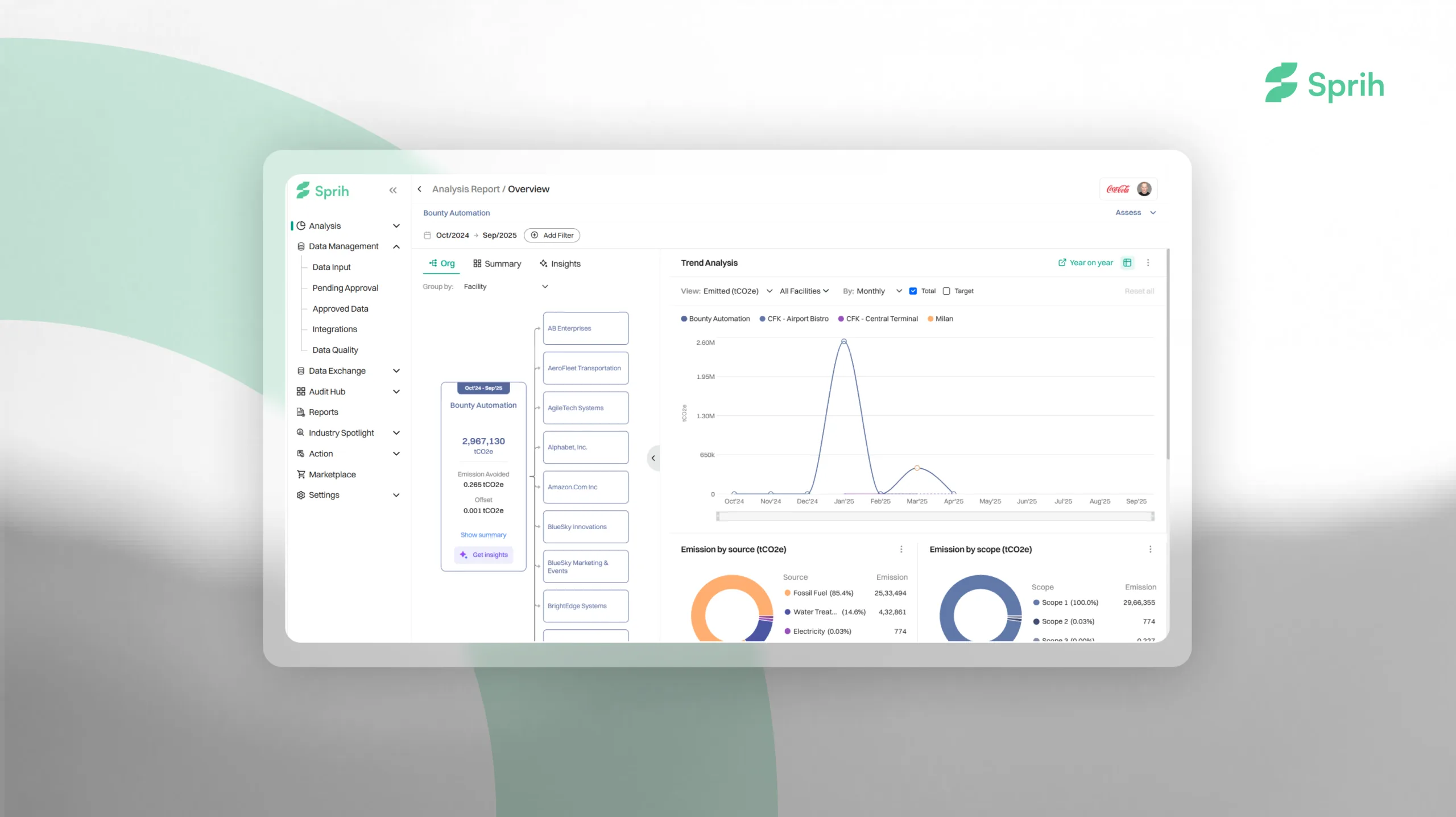
Sprih’s SustainSense AI engine is purpose-built for enterprise AI sustainability data collection automation. It learns from your historical data patterns, automatically identifies outliers and inconsistencies, and suggests corrections before they create audit liability.
The engine supports automated extraction from utility bills, invoices, and PDFs; applies the correct emission factors for your facilities and regions; and maintains complete audit trails for regulatory compliance. It integrates directly with your ERP systems and IoT platforms, normalizing data from diverse sources into a single, auditable record.
For enterprises managing emissions across dozens of frameworks—CSRD, BRSR, GHG Protocol, GRI, TCFD, ISSB—Sprih’s SustainSense AI engine ensures data consistency across all methodologies while flagging framework-specific differences that require human judgment.
Ready to explore how AI sustainability data collection works for your enterprise? See Sprih’s AI-native sustainability platform in action.
Here’s the hard truth: sustainability reporting is becoming competitive differentiation. Investors, regulators, and customers increasingly expect enterprises to have transparent, auditable, real-time sustainability metrics. Organizations that can produce trustworthy data quickly gain credibility and market advantage. Those still fighting with spreadsheets lose credibility and face mounting compliance risk.
AI removes the artificial bottleneck that has kept sustainability analytics trapped in the past. It doesn’t eliminate the need for strategy, judgment, or stakeholder engagement. But it eliminates the days and weeks wasted on mechanical data assembly and validation.
The enterprises winning in sustainability are those automating the routine and freeing human expertise for the strategic.
If your current approach still relies heavily on spreadsheets, email, and manual data entry, the opportunity is immediate. Here’s what to consider:
The future of sustainability reporting is not more sophisticated spreadsheets. It’s intelligent automation that extracts, validates, and contextualizes data in real time—giving your team the credibility and time to focus on the strategy that actually reduces emissions and improves sustainability performance.
For additional resources on emissions reporting frameworks, see the GHG Protocol Standards and the World Resources Institute’s climate guidance.
Ready to transform your sustainability data collection? See Sprih’s AI data engine in action—book a personalized demo today and discover how you can reduce data prep time by 75% while improving audit readiness and data quality.