
Carbon Pricing in India isn’t just an idea anymore, it’s becoming a full-fledged policy framework. From trading emissions credits to legally backed climate programs, the country is laying the groundwork for a national carbon market. Here’s what that actually means, how it works, and why it matters for India’s future.
At its core, carbon pricing makes polluters pay. Emit a tonne of CO₂, and you’re assigned a price, either through a tax or a market-driven system like Emissions Trading. The point isn’t to punish. It’s to nudge the economy toward cleaner energy, smarter production, and more efficient use of resources.
When markets work properly, carbon pricing becomes a powerful lever: companies that cut emissions benefit financially. Those that don’t, pay up.
India’s not just dabbling with the idea. It’s building a full ecosystem. The centrepiece is the Carbon Credit Trading Scheme (CCTS), launched in July 2024. This lays the foundation for the Indian Carbon Market (ICM), a national, regulated platform where companies can trade emission credits.
But here’s what makes India’s approach different: it’s starting with a rate-based Emissions Trading System (ETS). Unlike cap-and-trade, which sets an absolute limit on emissions, a rate-based system focuses on emissions intensity, how much you’re emitting per unit of output.
Why does this matter? Because India is still growing. A rate-based ETS allows flexibility for industries to scale, while still pushing them to decarbonize.
The CCTS will first apply to nine energy-intensive sectors, think steel, cement, aluminium, power, and similar heavy industries. Companies that beat their emissions intensity benchmarks can earn credits. Those that fall short must buy them. It’s that simple.
What’s also in motion:
Let’s zoom out for a moment. Compared to countries like China or Brazil, carbon pricing in India follows a distinct path that aligns with its growth priorities.
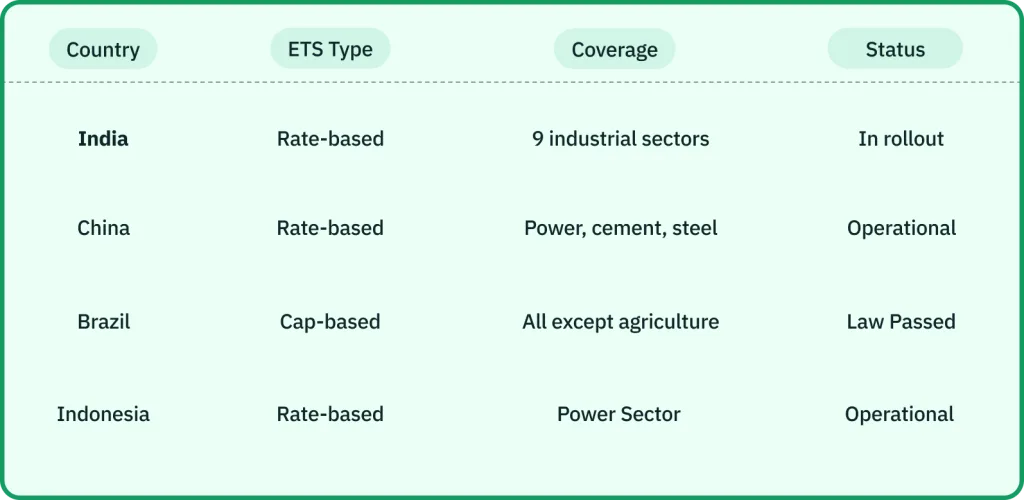
India is keeping pace with its peers—but in its own way. Rather than capping total emissions outright, it’s tying performance to output. That’s more aligned with its development needs.
Not every sector will fall under the ETS. That’s where voluntary carbon markets come in. India’s working on a crediting system that incentivizes climate-positive actions in sectors like:
The goal? Mobilize private capital. Support climate-friendly projects. And build a robust, transparent carbon credit registry.
This shift isn’t happening in isolation. A few key laws and missions are backing it:
To make this work, India set up multiple layers of oversight and implementation.
The BEE, under the Ministry of Power, is the main technical and regulatory authority. It develops rules, verifies emissions data, and issues credits.
This high-level committee includes ministry officials, state reps, and industry experts. It sets targets, recommends procedures, and monitors market function.
Carbon pricing isn’t just about factories and smokestacks. It’s also about people. That’s where Mission LiFE and the Green Credit Program come in.
Together, these programs make the carbon economy more participatory, not just regulatory.
India’s carbon market isn’t fully operational yet—but the scaffolding is up. In the next 12–18 months, expect:
There’s also a global dimension. With instruments like the EU’s Carbon Border Adjustment Mechanism (CBAM) looming, India’s push toward carbon pricing isn’t just climate policy—it’s economic self-defence.
India is building a carbon pricing system that fits its economic and climate realities. It won’t look like Europe’s or California’s—and that’s intentional. By focusing on emissions intensity, supporting voluntary action, and gradually expanding participation, India is designing a carbon market that’s flexible, scalable, and built for the long haul. The evolution of carbon pricing in India will be closely watched—by domestic industries, international investors, and regulators alike.
The tools are in place. The incentives are real. And for businesses, the message is clear: start decarbonizing—or start paying.
Want to understand what carbon pricing means for your business or sector? Talk to the climate experts at Sprih. Whether you’re navigating compliance, exploring carbon credits, or just figuring out where to start—we’re here to help you move from intention to impact.