Q1’25 product updates focused on introducing core capabilities that set the groundwork for scalable analytics, structured data governance, and enterprise-grade security. The updates below strengthened how organizations explore emissions, validate calculations, and manage access across the platform.
Here’s a look at how our engineering team strengthened the Sprih platform in Q1’25.
Analytics Dashboard — Central Hub for Data Visualization
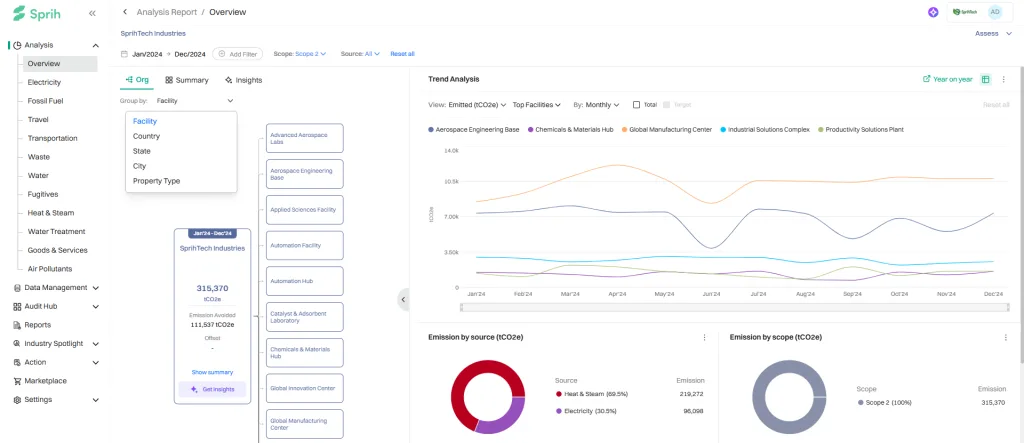
We launched a redesigned analytics dashboard to help users visualize and interpret sustainability data more effectively. A central interface for exploring emissions across scopes, sources, and facilities.
Organizational Hierarchy View: Analyze performance at any level of your organization’s structure.
Instant Summaries & Insight Cards: Quick contextual highlights for any selected group.
Interactive Trend Analysis: Point-in-time breakdowns and emitter comparison directly on the graph.
Advanced Filters: Tailor analysis by source, scope, facility, or top emitters.
Geospatial Mapping: A map view to understand emissions distribution across countries.
Audit & Data Transparency — Built for Verification and Compliance
We expanded audit capabilities to give users clearer, traceable insights into processed data.
Enhanced Audit Hub: Streamlined access to processed datasets and verification workflows.
One-Click Data Exports: Download structured processed data tables for reviews or reporting.
Applied EFs: View the exact emission factors used in calculations for complete transparency.
To strengthen organizational security, we introduced full Single Sign-On (SSO) support.
Multiple IdP Options: Integrations with Okta, Azure AD, and other enterprise providers.
Protocol Support: SAML and OAuth 2.0 for flexible authentication setups.
Sandbox Mode: Safe testing environment before production deployment.
SSO Management Panel: Admins can configure providers and user mappings directly in Settings.
Organization Management — Centralized Reference Data
A new organization profile allows admins to manage key company-level information in one place, including reporting details, revenue figures for intensity calculations, and company branding for dashboards and reports.
Expanded Emissions Coverage — New Sources Across Scopes
We added multiple new activity types to help organizations capture a broader range of emissions:
These additions support more accurate accounting across diverse operational activities.
A Strong Start to the Year
Q1 delivered the essential architectural and functional components that underpin the platform today. With major upgrades across analytics, data transparency, and authentication, the quarter established a stable, extensible base that enabled faster feature development and more sophisticated enhancements throughout the year.
FAQs
What was the main focus of Sprih’s Q2 2025 updates?
Q2 focused on enhancing analytical intelligence, tightening data governance, and improving overall usability. The goal was to help users gain deeper insights, streamline documentation workflows, and strengthen data security and audit transparency.
What’s new in the analytics experience?
Sprih introduced advanced features like year-over-year comparisons, tabular trend analysis, goal-tracking with target lines, and new KPI charts for water and waste. These capabilities give teams a richer understanding of their sustainability performance and make trend analysis far more intuitive.
How does year-over-year intelligence help users?
This feature allows users to seamlessly compare annual sustainability data, revealing progress, shifts, and emerging patterns across multiple reporting cycles. It helps organizations put their data in context and evaluate long-term impact.
What are quantity-based KPI charts?
Quantity-based KPI charts visualize resource usage like water and waste volumes, helping teams analyze consumption and disposal trends. They provide a clearer, data-driven view of how resource management aligns with sustainability targets.
How has documentation and verification improved?
Users can now attach multiple categorized proofs to data entries and maintain a facility-specific document library. This structure simplifies validation, centralizes compliance materials, and builds a stronger audit trail across operations.
What’s new in the Audit Hub?
The Audit Hub now offers complete visibility into calculation breakdowns for emissions, energy, and losses. This transparency supports external audits, internal reviews, and quality assurance, helping teams verify data with confidence.
What are the new Viewer and Auditor roles?
Two new governance roles were introduced:
Viewer — Read-only access across dashboards and data management.
Auditor — Access restricted to processed data and emission factor details.
These roles improve control, accountability, and audit readiness across teams.
What is the Report Archival feature used for?
Admins can upload past reports (PDFs) into a central archive, creating a searchable library of historical data. This ensures that AI-driven workflows and teams have the context needed for trend analysis and long-term performance review.
What changes were made to strengthen account security?
Sprih rolled out one-time-password (OTP) login authentication. Every user now signs in using an emailed OTP, adding a stronger layer of protection against unauthorized access and aligning with enterprise-grade security standards.
How do these updates improve the user experience?
The updates deliver smoother navigation, richer analytics, and stronger oversight — making sustainability management simpler and more secure. Together, they empower teams to measure and manage sustainability performance with greater clarity and confidence.