If your company is preparing for CSRD, IFRS S2, or California climate disclosure laws, you’re already operating inside a framework that TCFD built. Most enterprises don’t realize this. They treat it as one more acronym on a long list when, in practice, it’s the structural foundation almost every major climate reporting standard sits on. Understanding TCFD isn’t background reading — it’s the starting point for getting disclosure right.
What Is TCFD?
It stands for the Task Force on Climate-related Financial Disclosures. The Financial Stability Board (FSB) created it in 2015 to improve and increase reporting of climate-related financial information. The task force was chaired by Michael Bloomberg and brought together leaders from banking, insurance, asset management, and corporate sectors.
Following the release of the Task Force’s 2023 Status Report, upon request of the FSB, the TCFD was disbanded. Its remit was complete. The FSB asked the IFRS Foundation to take over monitoring the progress of companies’ climate-related disclosures.
But it didn’t disappear — it was absorbed. The ISSB’s IFRS S2 standard, which governs climate disclosure under the IFRS Sustainability Disclosure Standards, is built directly on the TCFD framework. Companies reporting under IFRS S2 are, in practice, implementing it.
Why TCFD Was Created
Financial markets need clear, comprehensive, high-quality information on the impacts of climate change — including the risks and opportunities presented by rising temperatures, climate-related policy, and emerging technologies.
Before Task Force on Climate-related Financial Disclosures, climate disclosure was fragmented. Companies reported different things in different formats, making it nearly impossible for investors to compare exposure across sectors or portfolios. TCFD standardized the structure.
The recommendations are designed to solicit decision-useful, forward-looking information that can be included in mainstream financial filings. That’s a meaningful design choice — climate risk belongs in the same document as financial risk, not in a separate sustainability report that CFOs don’t read.
The Four Pillars of TCFD
The recommendations are structured around four thematic areas that represent core elements of how organizations operate: governance, strategy, risk management, and metrics and targets.
Governance
Disclose the organization’s governance around climate-related risks and opportunities — specifically the board’s oversight and management’s role in assessing and managing those risks.
This pillar asks: who owns climate risk inside the company? It needs to be someone with real accountability, not a sustainability team working in isolation.
Strategy
Disclose the actual and potential impacts of climate-related risks and opportunities on the organization’s businesses, strategy, and financial planning where such information is material.
This includes short-, medium-, and long-term horizons. It also requires describing the resilience of the organization’s strategy, taking into consideration different climate-related scenarios, including a 2°C or lower scenario.
Scenario analysis is the hardest part for most companies. It forces you to model plausible futures — carbon pricing, physical risk, regulatory shifts — and stress-test your current strategy against them.
Risk Management
Disclose how the organization identifies, assesses, and manages climate-related risks — and how those processes are integrated into the organization’s overall risk management.
The integration piece matters. Climate risk managed by one team, in a separate process, disconnected from enterprise risk management, doesn’t count as managed.
Metrics and Targets
Disclose the metrics and targets used to assess and manage relevant climate-related risks and opportunities. This includes disclosing Scope 1, Scope 2 and, if appropriate, Scope 3 greenhouse gas (GHG) emissions and the related risks.
Scope 3 is where supply chains live. For most enterprises, supplier emissions account for the majority of their carbon footprint. Measuring them accurately is, for most companies, the hardest metric in the framework — and the one regulators are watching most closely.
The Scale of Adoption
Since the launch of the TCFD’s recommendations report in 2017, nearly 5,000 organizations publicly declared their support in 103 jurisdictions. Supporters ranged from global banks and insurance firms to manufacturers, airlines, and exchanges.
Adoption moved from voluntary to near-mandatory. Regulators in the UK, EU, Singapore, Japan, and Hong Kong embedded TCFD-aligned requirements into law. In the US, the SEC’s climate disclosure rule draws directly from it. The framework didn’t stay voluntary for long.
TCFD vs. ISSB: What Changed After 2023
When TCFD disbanded in October 2023, the IFRS Foundation (and its standard-setting arm, the ISSB) took over monitoring. IFRS S2, the climate-specific standard, is TCFD-aligned by design. If your company is reporting under IFRS S2, you’re implementing TCFD.
CSRD in the EU includes ESRS E1, which covers climate — also structurally aligned with TCFD’s four pillars.
The upshot: the four pillars aren’t going anywhere. Any company building a climate disclosure program today is building on the foundation, whether they call it that or not.
What It Means for Supply Chain Teams
Scope 3, Category 1 (purchased goods and services) is where most enterprise carbon sits. TCFD’s Metrics and Targets pillar asks companies to disclose Scope 3 emissions where appropriate. For companies in sectors with significant upstream impact — consumer goods, pharma, electronics, apparel — appropriate almost always means required.
The problem most companies face isn’t data absence. Suppliers exist. Sustainability reports exist. Regulatory filings exist. The problem is translation: turning fragmented supplier data into disclosure-ready numbers. That’s an infrastructure problem as much as a measurement problem.
The 7 Principles for Effective Disclosure
To help achieve high-quality disclosures that enable users to understand the impact of climate change on organizations, the Task Force recommends that firms consider seven principles for effective disclosure: disclosures should be relevant, specific and complete, clear and understandable, consistent over time, comparable among companies within a sector, reliable and verifiable, and provided on a timely basis.
These principles are worth reading carefully. “Comparable among companies within a sector” is particularly important — it’s why generic, narrative-heavy disclosures are falling out of favor. Investors want numbers they can stack against competitors.
How Sprih Helps
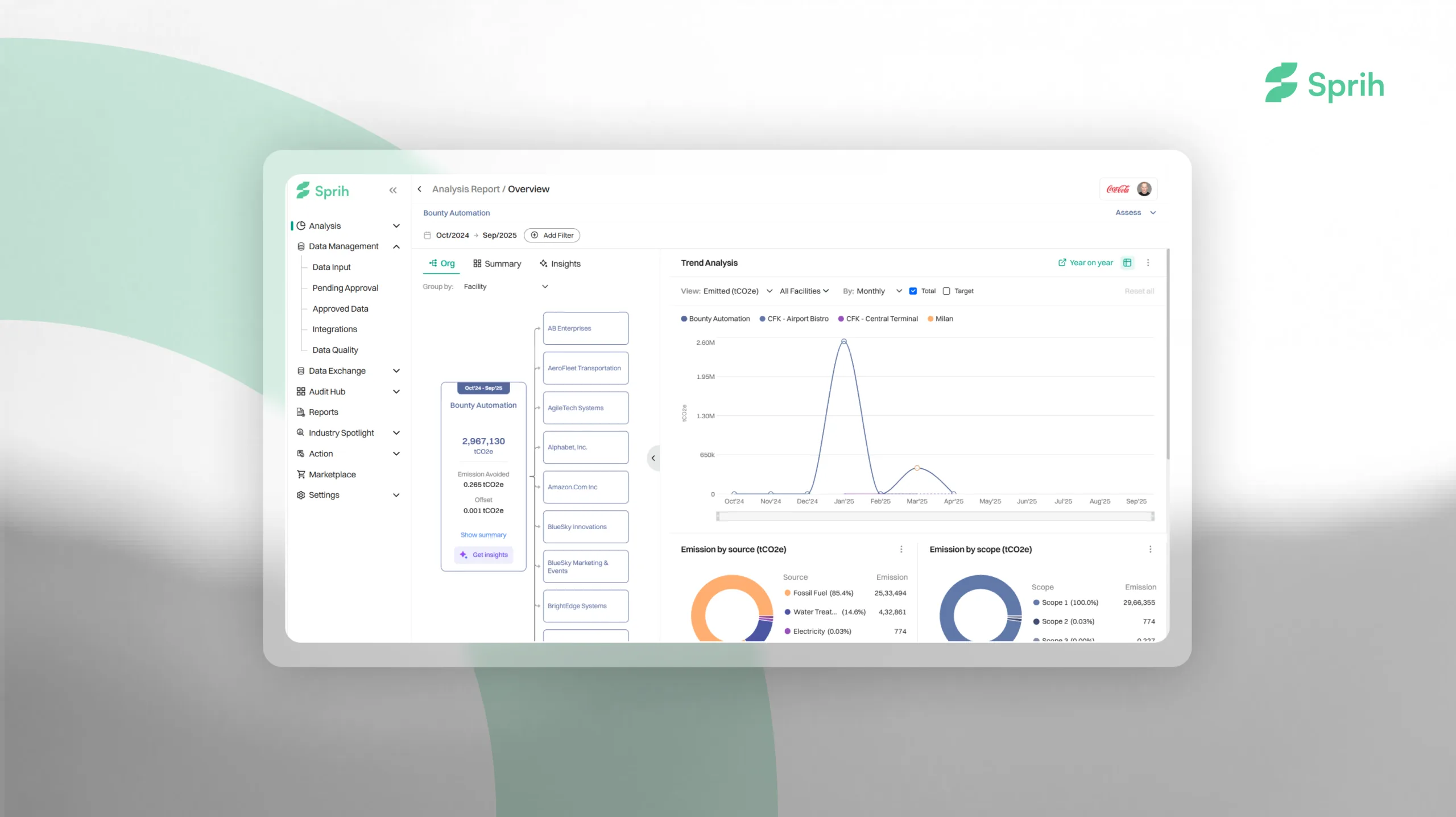
Task Force on Climate-related Financial Disclosures’ Metrics and Targets pillar — particularly Scope 3 emissions — is where most enterprises hit a wall. Supplier data is scattered across surveys, public registries, sustainability reports, and regulatory filings. Aggregating it manually is slow, inconsistent, and difficult to audit. Sprih’s AI-native platform, built on SustainSense, ingests and structures data from over 120,000 companies and 300,000 sustainability reports to give procurement and sustainability teams decision-ready supplier intelligence.
Instead of asking suppliers for data and hoping the responses are accurate, Sprih pulls from what already exists — public disclosures, regulatory filings, emissions databases — and translates it into the format your disclosure requires. For companies preparing for the disclosure under IFRS S2 or CSRD, that’s the difference between a disclosure process and a disclosure program.
FAQs
What does TCFD stand for?
It stands for the Task Force on Climate-related Financial Disclosures. It was created by the Financial Stability Board (FSB) in 2015 to develop a global framework for companies to disclose climate-related financial risks and opportunities.
Is TCFD still active?
It officially disbanded in October 2023 after completing its remit. The IFRS Foundation now monitors progress on climate-related disclosures. The TCFD framework itself remains the structural basis for IFRS S2, CSRD’s ESRS E1, and several national regulatory regimes.
What are the four pillars of TCFD?
The four pillars are Governance (board and management oversight of climate risk), Strategy (impact of climate risks and opportunities on the business), Risk Management (how climate risks are identified and managed), and Metrics and Targets (quantitative disclosures including Scope 1, 2, and 3 GHG emissions).
Is TCFD reporting mandatory?
TCFD-aligned reporting is now mandatory in several jurisdictions. The UK, EU (via CSRD), Singapore, Japan, Hong Kong, and New Zealand have all embedded TCFD requirements into law or regulation. In the US, the SEC’s climate disclosure rule is TCFD-aligned. Globally, IFRS S2 — also built on TCFD — is being adopted as the international baseline.
What is the difference between TCFD and IFRS S2?
IFRS S2 is the ISSB’s climate-specific disclosure standard, released in 2023. It is built directly on the TCFD framework and uses the same four-pillar structure. Companies implementing IFRS S2 are, in practice, implementing TCFD. The key difference is that IFRS S2 is a formal accounting standard with more detailed application guidance.
Does TCFD require Scope 3 emissions disclosure?
Yes, it requires companies to disclose Scope 3 emissions where appropriate. For most enterprises in sectors with significant supply chain impact — consumer goods, pharma, electronics, apparel — regulators and investors generally treat Scope 3 disclosure as expected. Standards built on TCFD, such as IFRS S2 and CSRD, include more explicit Scope 3 requirements.
What is scenario analysis under TCFD?
Scenario analysis is a process for assessing the potential impact of different future climate states on your business. TCFD recommends that companies model at least one scenario aligned with a 2°C or lower warming pathway. The goal is to test the resilience of your strategy against plausible futures — including policy changes, carbon pricing, and physical risks — rather than just reporting on historical performance.
What is the relationship between TCFD and CSRD?
CSRD (the EU’s Corporate Sustainability Reporting Directive) uses the ESRS E1 standard for climate reporting, which is structurally aligned with TCFD’s four pillars. Companies reporting under CSRD will find that their TCFD-aligned processes map directly to ESRS E1 requirements, though CSRD also includes additional double materiality requirements not present in the original TCFD framework.
How many companies supported TCFD?
By the time TCFD fulfilled its remit in 2023, nearly 5,000 organizations across 103 jurisdictions had publicly declared support for its recommendations. Supporters included global banks, insurers, asset managers, manufacturers, and exchanges.
How does TCFD affect procurement and supply chain teams?
TCFD’s Metrics and Targets pillar requires Scope 3 GHG disclosures, which cover upstream supplier emissions (Category 1) and downstream emissions. For most enterprises, this means procurement teams need reliable supplier emissions data. Surveys alone are insufficient — companies are moving toward AI-driven approaches that pull from existing supplier disclosures, regulatory filings, and public sustainability reports.