In today’s fast-evolving regulatory landscape, SASB Standards have emerged as a cornerstone for ESG reporting that speaks the language of investors. With a sharp focus on financial materiality and industry-specific metrics, these standards help organizations across 77 industries identify and disclose the ESG issues that directly impact enterprise value.
Let’s unpack what the SASB Standards are, why they matter now more than ever, and how they’re evolving alongside the International Sustainability Standards Board (ISSB) and IFRS S2 guidance.
The Sustainability Accounting Standards Board (SASB), established in 2011, is a non-profit body that developed a suite of industry-specific disclosure standards to guide the communication of material sustainability information to investors.
These standards go beyond general ESG checklists. They zoom in on how environmental, social, and governance factors uniquely impact financial performance in specific industries—from airlines to pharmaceuticals to fintech.
SASB Standards cover five key sustainability dimensions:
Each industry’s standard outlines six key topics and 13 metrics that serve as a baseline for disclosure.
Climate risks and ESG concerns are no longer peripheral—they are central to business strategy and valuation. However, investors often struggle with fragmented, non-comparable data.
SASB solves this by offering:
For businesses, this clarity simplifies the process of meeting investor expectations while aligning with evolving global reporting frameworks.
SASB’s standards were shaped through a rigorous open process that blended:
The result? Standards that are precise, applicable, and forward-looking.
Here’s what makes SASB unique:
A sustainability issue in mining looks very different from one in software. SASB standards reflect those nuances—helping companies report what truly matters for their sector.
SASB focuses on the subset of ESG issues likely to influence a company’s financial condition or operating performance—making it a natural fit for investor-centric disclosures.
While developed in the U.S., SASB’s metrics are globally relevant. Over 2,200 companies across 66 markets and 70+ jurisdictions use them today.
To help companies navigate their reporting responsibilities, SASB offers two practical tools:
This interactive visual tool shows which of 26 general sustainability issues are financially material to each of the 77 industries. It groups sectors like consumer goods, transportation, and technology—then highlights issues like water use or data security depending on the sector.
This allows users to compare ESG topics across up to four industries, helping stakeholders understand sector-specific risks and opportunities.
In 2022, SASB became part of the International Financial Reporting Standards (IFRS) Foundation, under the oversight of the newly formed International Sustainability Standards Board (ISSB).
Now, SASB is shaping the industry-specific guidance in IFRS S2—a global framework for climate-related disclosures. While SASB identifies what’s material to each sector, IFRS S2 adds structure for how to report it.
To stay aligned, the ISSB has released an Exposure Draft in July 2025 proposing several enhancements to the SASB Standards:
These revisions are designed to enhance transparency, maintain global alignment, and make climate-related disclosures more useful for investors.
SASB isn’t meant to replace other frameworks. Instead, it integrates with them to provide a more complete ESG picture.
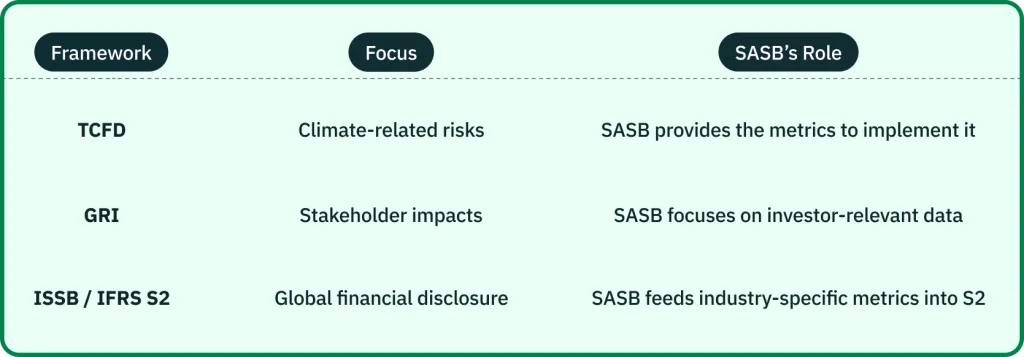
By leveraging SASB alongside these frameworks, companies can meet both stakeholder and investor needs with precision.
With the ISSB now overseeing the evolution of sustainability standards, SASB is becoming even more powerful. The path forward is clear: a globally consistent, investor-focused ESG reporting landscape.
Companies that embrace SASB now will not only be ahead of regulation—they’ll be better equipped to attract capital, manage risk, and unlock long-term value.
In a world demanding accountability, SASB Standards offer a practical, data-driven foundation for ESG reporting that speaks directly to investors. As sustainability becomes synonymous with financial strategy, the SASB-IFRS S2 alignment signals a major shift toward global coherence.
Organizations that start aligning today will lead the way tomorrow.
Sprih’s AI-native unified platform can help you simplify sustainability reporting, automate emissions tracking, and stay ahead of regulatory change. Let’s make sustainability actionable—get in touch today.