New York Part 253 greenhouse gas reporting is now a binding regulatory requirement, not a policy proposal. With 6 NYCRR Part 253 finalized, the New York Department of Environmental Conservation has established an economy-wide emissions reporting framework that fundamentally changes how statewide emissions data is collected, verified, and made public.
The point is straightforward: build a consistent, source-specific dataset for emissions across major stationary sources, fuel suppliers, electricity import/export, waste exporters, and several other categories. The rule is explicitly framed as a data-collection program, New York’s Department of Environmental Conservationnot an emissions cap, not an allowance obligation, not a direct reduction mandate.
But here’s what’s really going on: once a state creates a single reporting spine that reaches beyond smokestacks into fuels and imported electricity, it changes what “statewide emissions” even means in practice. It also changes what companies will be expected to substantiate, year over year, with enforceable deadlines, auditable records, and, above certain thresholds, third-party verification.
This is an explainer written for the entities that will have to report. It’s organized around what you need to decide, build, and document to avoid a messy first filing.
The regulation’s purpose is to establish a mandatory greenhouse gas reporting program that provides information about GHG emissions from GHG emission sources.
Two practical implications flow from DEC’s framing:
That said, companies should treat Part 253 as more than a paperwork exercise. Once emissions are reported annually in a state-administered system and defined as public information (more on that below), the data becomes usable well beyond regulatory compliance.
Part 253 covers multiple “reporting categories.” Your first task is to identify which category you fall into and whether the thresholds apply.
DEC’s FAQ lays out who must report under Part 253 as “Reporting Entities,” including (in plain terms):
DEC’s FAQ addresses a common problem: co-located sites, third-party operators, and split ownership/operation models. The rule’s concept of “operational control” matters, and DEC notes that where authority is shared and one party holds a DEC permit to operate, that party is considered to have operational control for Part 253 purposes.
If you’re in a contractual operating arrangement, don’t assume the reporting obligation lands where it’s convenient. Map operational control explicitly and document the rationale early.
Most corporate inventories default to 100-year global warming potentials (GWP100). Part 253 does not. DEC states that for this reporting program, GWP20 will be used to calculate CO2e consistent with New York’s Climate Act accounting approach and DEC’s Part 496 framework.
For methane-heavy sources (waste, oil and gas systems, some agricultural-related emissions), GWP20 materially increases the CO2e value relative to GWP100. That affects:
If your internal reporting and your Part 253 reporting will coexist, plan now for how you will reconcile GWP20-based figures with any GWP100-based disclosures you publish elsewhere. The reconciliation itself is not optional if you want to avoid confusion and credibility issues later.
The rule’s deadlines create a simple rhythm: measure in the emissions year, report by June 1 the following year, and (if applicable) verify on DEC’s schedule.
Each reporting entity must submit an emissions data report no later than June 1 of the year immediately following the emissions year; DEC explicitly states that 2026 emissions year data is due June 1, 2027.
If you are subject to verification, DEC requires the verification body to submit verification statements by:
DEC is also explicit that hiring a verifier late is not an excuse—your obligation is to ensure verification statements are submitted by the deadline.
For many companies, 2026 is the real start date, even though the first submission is 2027. If you wait until early 2027 to design monitoring and data systems, you will be reconstructing a year of activity under time pressure.
At the highest level, GHG emissions are reported in metric tons of CO2e.
But Part 253 is built to allow DEC to compute emissions from standardized emission factors when appropriate, especially for suppliers and activity-based categories. DEC’s fact sheet describes the mechanics: entities can use available information about fuel volumes/utilization/activities applied to standardized formulas or emission factors to generate GHG emission data, and DEC provides an estimator tool as an approximation aid (not legally binding).
This is where reporting entities need to be careful:
DEC’s FAQ addresses a specific confusion point: electricity purchases for field offices and corporate buildings may be excluded if they do not generate emissions, energy outputs, or products covered by the rule and are not part of or in support of covered industrial activities; DEC has excluded reporting for electricity purchased from a utility at an established market rate.
This is an example of the broader point: Part 253 is not trying to become a full Scope 2 corporate inventory. It is building a regulated-source dataset.
Part 253 creates a second tier: Large Emission Sources, which triggers third-party verification (subject to additional nuances and exemptions).
Part 253’s express terms set these thresholds, including:
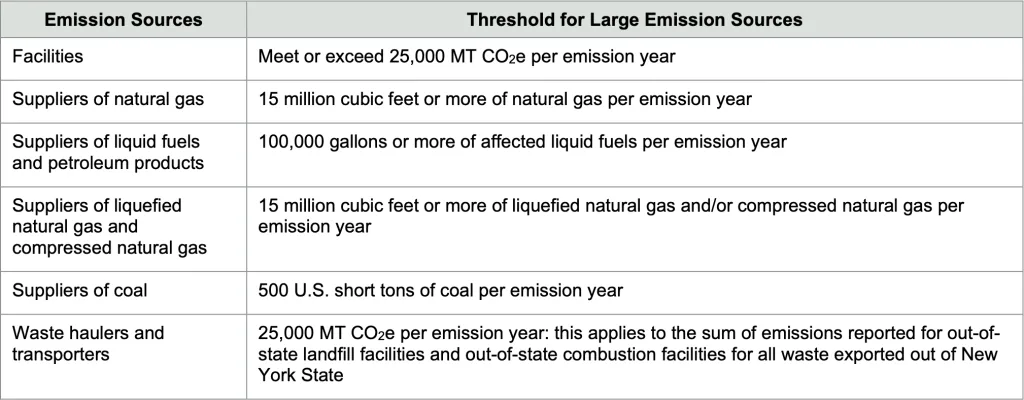
DEC’s FAQ also summarizes that only Large Emission Sources must verify, via DEC-accredited third-party verifiers.
DEC defines verification as evaluating the emissions data against DEC reporting procedures, including methods for calculating and reporting emissions and product data to ensure accuracy.
Treat this like financial audit prep: if your underlying activity data, meter records, sampling regimes, or calculation workpapers are messy, the verification cycle will surface it.
DEC’s FAQ states that certain operators must develop and implement an operation- or facility-specific Emissions Monitoring and Measurement Plan (pursuant to 253-2.20), including:
Even if you’re not in these subcategories, the direction of travel is clear: DEC is building a system where data quality and measurement traceability matter, especially for higher-emitting and higher-uncertainty categories.
Part 253 requires submission through NYS e-GGRT (New York State electronic greenhouse gas reporting tool) or another DEC-approved reporting tool that guarantees transmittal and receipt.
The FAQ notes the formal platform is under development; the estimator tool is explicitly “illustrative” while the electronic platform is developed for launch before the first annual report is due.
What reporting entities should do now:
Recordkeeping is not an afterthought in Part 253.
The practical point: you need a record retention architecture that survives staff turnover, reorganizations, and vendor changes. If the knowledge sits in one person’s spreadsheets, you’re taking a compliance risk you don’t need.
Part 253 is blunt: emissions data submitted under this Part is public information and shall not be designated as confidential.
DEC also states that data reported to EPA under Part 98 that has been released publicly is considered public information by DEC.
You can claim confidentiality for other information you submit, but it must be clearly identified as confidential, based on a belief it is a trade secret or otherwise exempt under New York’s Public Officers Law, and handled under DEC’s confidentiality procedures.
Translation for companies: expect your emissions totals to be readable by outside stakeholders. If you have historically managed emissions visibility through selective disclosure, Part 253 will constrain that.
Part 253’s enforcement provision matters because it defines what counts as a violation:
DEC’s FAQ also signals an implementation posture: an initial phase focused on education and outreach before formal enforcement, but with escalation for repeated noncompliance; it also notes that DEC may develop and assign emissions for a reporting entity that fails to submit required reports or verification statements.
Finally, DEC’s express terms include broad access rights: the department may access real property where an emission source exists during normal business hours, inspect, take measurements/samples, and conduct activities necessary to evaluate emissions and compliance; establishing a reporting account may be considered written permission for access.
If you want a clean first filing, build the program around five workstreams:
Part 253 is not just another state program layered onto existing reporting. It is a signal that state-level emissions transparency is becoming infrastructure: consistent methods, annual cadence, public emissions totals, and verification above certain thresholds.
If more states build reporting systems that reach beyond facilities into fuels and imported electricity, two things follow. First, corporate and industrial emitters will face a de facto expectation of multi-jurisdictional consistency (including explicit handling of methodological differences like GWP20 vs GWP100). Second, the public availability of source-specific emissions data will raise the baseline for what investors, customers, and communities consider “normal” transparency.
For reporting entities, the near-term goal is simple: get the first reporting years right. The longer-term reality is bigger: once state-level reporting becomes durable and comparable, emissions data stops being a periodic disclosure exercise and starts functioning like a standing public record—one that will increasingly shape permitting, procurement, reputation risk, and policy design over the next few years.
As companies move from interpreting Part 253 to actually operationalizing it, the difference between a clean first filing and a painful one will come down to preparation, data discipline, and clarity on responsibility. New York has set a high bar for emissions reporting, and that bar is unlikely to move down over time. If you want to sanity-check applicability, pressure-test your reporting approach, or understand what “good” looks like before 2026 data collection begins, connecting with an expert can save months of rework. The Sprih team examines closely the reporting entities navigating state and federal emissions reporting, and can help translate regulatory requirements into practical, defensible reporting systems.
Connect with us now!