Choosing the wrong sustainability software is expensive. You’ll spend $50K–$500K implementing a platform that doesn’t fit your needs, train teams on a system that won’t scale, and three years in, you’ll realize you need to migrate to something better. The cost of switching is brutal: data migration, retraining, lost productivity, and consulting fees that dwarf the original software cost.
So before you evaluate platforms, you need to know what you’re looking for. This guide covers the eight essential criteria for how to choose sustainability software in 2026.
How to Choose Sustainability Software: An Essential Guide
Why Choosing the Right Sustainability Platform Matters
Sustainability software touches every part of your organization: emissions tracking, reporting, compliance, supply chain management, investor relations, and board governance. When learning how to choose sustainability software, remember it’s not like choosing a point solution (a single-purpose tool like a carbon calculator). It’s a foundational system.
Choosing poorly has downstream consequences:
- Compliance failure: Platform doesn’t support your regulatory frameworks (CSRD, BRSR, ISSB); you miss reporting deadlines or fail audits
- Scope 3 gaps: Platform can’t handle supply chain emissions or financed emissions; you’re stuck with incomplete reporting
- Audit readiness failure: Platform doesn’t produce audit trails; auditors qualify their opinion
- Scalability failure: Platform works for 5 facilities; breaks at 500; you outgrow it in 18 months
- Integration hell: Platform is a silo; doesn’t talk to your ERP, finance systems, or data warehouse
- Vendor lock-in: Expensive migration costs trap you in a suboptimal platform
Getting it right the first time saves hundreds of thousands in avoided rework and enables your team to focus on strategy instead of data wrangling.
The 8 Criteria to Evaluate Sustainability Software
1. Scope Coverage: Does It Handle All Three Scopes?
Not all sustainability platforms are equal on scope coverage. Some platforms are excellent at Scope 1 & 2 but weak on Scope 3. Others focus narrowly on carbon and ignore water, waste, or social metrics.
What to ask:
- Scope 1 (direct emissions): Can it handle natural gas, fuel oil, fugitive refrigerants, process emissions, company vehicles? Can it integrate with utilities data feeds or import from building management systems?
- Scope 2 (purchased electricity): Does it support both market-based and location-based accounting? Can it incorporate renewable energy certificates and power purchase agreements? Does it handle grid carbon intensity by region?
- Scope 3 (indirect emissions): Here’s where platforms diverge. Ask specifically:
- Does it support all 15 categories? Or just a subset (e.g., only supply chain)?
- Can it handle supplier emissions data (questionnaires, CDP, third-party databases)?
- Does it support financed emissions (for banks/asset managers)?
- Can it estimate Scope 3 for non-reporting suppliers (using spend-based, revenue-based, or proxy methods)?
- Does it include customer use phase (product use emissions) and end-of-life?
Red flag: Platform that only does Scope 1 & 2. Most enterprises have 80%+ of emissions in Scope 3. A platform that ignores it won’t scale.
Ask for: Proof of concept with your actual data to validate scope coverage works for your operations.
2. Framework Support: Which Reporting Standards Does It Support?
sustainability reporting requirements vary by jurisdiction and audience. Your platform must support the specific frameworks you’re required to use (and ideally, the ones your investors want).
Must-have frameworks (depending on jurisdiction):
- CSRD (EU): Mandatory for large EU companies; requires double materiality assessment, Scope 3, decarbonization strategy, due diligence
- BRSR (India): Mandatory for NSE/BSE-listed companies; structured disclosure format
- GRI (Global): Most widely used globally; 40+ metrics across environment, social, governance
- TCFD (Climate-focused): Increasingly expected by investors and required by regulators in UK, Australia, Singapore
- ISSB/IFRS S1 & S2 (Emerging global baseline): Becoming mandatory in EU, UK, Australia; will dominate going forward
- SB 253 (California): Applies to large companies operating in California; requires Scope 1, 2, 3 disclosure
- SEC Climate Rule (U.S.): Proposed rule includes Scope 1, 2, financed emissions; final form uncertain but likely
- Industry-specific: SASB standards for your industry sector
What to ask:
- Which frameworks are supported out-of-the-box vs. customization?
- When new frameworks emerge (like ISSB), how quickly does the platform add support?
- Can the platform map your core dataset to multiple frameworks automatically, or do you maintain separate datasets for each?
Red flag: Platform that requires manual mapping to different frameworks. You’ll end up with multiple spreadsheets again.
Ideal scenario: Single dataset, multi-framework reporting. You enter data once; the platform generates reports for GRI, TCFD, CSRD, BRSR, ISSB, and SASB simultaneously.
3. Data Ingestion Flexibility: How Does Data Get Into the System?
sustainability data comes from everywhere: utility PDFs, facility sensors, supplier questionnaires, travel systems, finance databases, third-party emissions databases. Your platform needs to be flexible on intake.
Ask what the platform supports:
- Manual entry: For small datasets or one-time entries (acceptable, not ideal at scale)
- File import: Excel, CSV, or structured data files from your systems
- PDF parsing: Can it automatically extract data from utility bills, invoices, travel receipts? (AI-powered platforms excel here)
- API integrations: Can it connect directly to your ERP, HR system, travel system, building management system, utility provider, CDP database?
- Database integrations: Can it pull data from your data warehouse or lake?
- Supplier questionnaires: Built-in questionnaire module with automated follow-up and data validation?
- Third-party emissions databases: Does it integrate with carbon footprint databases, supplier emissions lists, or product-specific LCAs?
- IoT/sensor data: For companies with thousands of sensors, can it ingest real-time data from building automation systems, energy monitoring systems, or manufacturing systems?
What this buys you: Automation. The less manual data entry, the fewer errors, the less admin burden. Modern platforms use AI to parse PDFs and extract structured data, reducing manual keying by 80%+.
Red flag: Platform that requires spreadsheets or manual entry for all data. You haven’t solved the problem; you’ve just moved it to a new tool.
Ask for: A data ingestion walkthrough with your actual data sources. If they can’t quickly ingest your utilities data, energy bills, or supplier lists, move on.
4. AI and Automation Capabilities: Does It Intelligently Handle Complexity?
This separates leading platforms from also-rans. AI-native platforms reduce manual work through:
- Intelligent data parsing: Extracts structured data from unstructured sources (PDFs, emails, forms)
- Automated supply chain estimation: Estimates Scope 3 emissions for non-reporting suppliers using spend-based or industry benchmarks
- Anomaly detection: Flags unusual data (a 50% spike in facility emissions) and triggers review
- Automated compliance checking: Validates data against regulatory requirements and flags gaps
- Report generation: Generates audit-ready reports in minutes, not weeks
- Scenario modeling: Models emissions impact of different business scenarios (growth, efficiency, offsets)
Ask specifically:
- Can it auto-generate supplier emissions questionnaires and send them out with reminders?
- Can it estimate Scope 3 for suppliers who don’t respond (using proxy data)?
- Does it have AI-powered anomaly detection to flag data quality issues?
- Can it auto-draft reports from your data, or do you still manually compile numbers?
- Does it help you identify emissions hotspots and reduction opportunities?
Why this matters: AI automation reduces the time to generate a compliant report from 4–8 weeks (manual process) to days. For a sustainability team of 3–5 people, this is the difference between possible and impossible.
Red flag: Platform that positions itself as just a “data repository.” You’re still doing the analytical work manually.
5. Audit Trail and Assurance Readiness: Is the Data Audit-Proof?
With CSRD and other regulations mandating third-party assurance, your platform must produce audit-ready data and reports.
Ask about audit capabilities:
- Calculation transparency: Can auditors see exactly how every number was calculated?
- Source traceability: Is there an audit trail showing where every data point came from?
- Version control: Does the platform track changes (who changed what, when, why)?
- Documentation support: Can you attach source documents (utility bills, invoices, questionnaires) to each data point?
- Review workflow: Does it support documented review and approval steps?
- Scope definitions: Can you define and document your scope boundaries (facilities, suppliers, business units included/excluded)?
- Restatement tracking: If you correct a prior-year number, does the platform document the reason and impact?
- Export for auditors: Can you generate audit-ready reports with full supporting documentation?
What auditors actually need: For limited assurance (CSRD 2024), auditors need to see data origin, calculation logic, and evidence of review. For reasonable assurance (CSRD 2028+), they need even more: independent verification of samples, deep-dive testing of controls, and clear documentation of everything.
Red flag: Platform that says “audit ready” but doesn’t show calculation transparency or source tracing. You’ll still be scrambling to reconstruct data when auditors arrive.
Test this: Ask for a demo of the audit trail. Walk an auditor (or simulate one) through how they’d verify a number. If you can’t confidently trace from reported number back to source in 5 minutes, the platform isn’t audit-ready.
6. Supply Chain and Scope 3 Features: Can It Handle Complexity at Scale?
Scope 3 (supply chain) emissions are the biggest and most complex for most enterprises. A robust platform should have:
- Supplier portal: Where suppliers submit emissions data or answer questionnaires
- Automated supplier outreach: Sends questionnaires, reminders, and escalations
- Data validation: Checks supplier data for completeness and reasonableness
- Tiering: Can handle primary suppliers, secondary suppliers, and deeper tiers
- Proxy estimation: When suppliers don’t report, automatically estimates using spend-based or industry benchmarks
- Spend integration: Connects to procurement systems to capture supplier spend and automatically trigger data requests
- Category-specific calculation: Different calculation logic for different Scope 3 categories (supply chain, use phase, end-of-life, etc.)
Why this matters: Most enterprises have hundreds or thousands of suppliers. Managing their emissions data manually is nearly impossible. A platform that handles supplier engagement, estimation, and validation at scale is game-changing.
Ask for: A live demo of the supplier portal and automated engagement workflow. Can it actually engage 500 suppliers and manage data collection from them?
7. Enterprise Scalability: Will It Grow With You?
You might start with 10 facilities. But if you acquire companies, expand geographically, or consolidate operations, you’ll have 100 or 500 facilities. Your platform must scale without reimplementation.
Ask about scalability:
- Multi-entity support: Can it handle 1,000+ facilities, business units, or legal entities?
- Multi-region/multi-currency: Does it support operations across continents with different grid carbon intensities, currencies, and regulatory frameworks?
- Multi-user collaboration: Can 50+ people use it simultaneously (sustainability team, finance, operations, supply chain)?
- Single sign-on (SSO): Can it integrate with your corporate identity provider (Okta, Azure AD, etc.)?
- Data volume: Can it handle billions of data points (thousands of facilities × months/years of historical data)?
- Performance: Does it stay responsive under load, or does it slow down when you run complex queries?
- Data warehouse integration: Can it feed cleaned, validated data into your data warehouse for deeper analysis?
Why this matters: A platform that works for 10 facilities might collapse at 500. Migration costs are enormous. Choose for scale from the start.
8. Vendor Expertise and Support: Do They Know sustainability?
Sustainability reporting is evolving rapidly. Frameworks change, regulations tighten, best practices shift. Your vendor should have deep expertise and ongoing support.
Ask about vendor capabilities:
- sustainability expertise: Do their team members have sustainability certifications (GRI, LEED, ISO 14001)? Have they worked with similar companies?
- Regulatory expertise: Do they track regulatory changes? Do they update the platform when new frameworks launch (like ISSB)?
- Customer success team: Do they have dedicated customer success managers who proactively help you optimize the platform?
- Professional services: Can they help with implementation, data migration, and training?
- Advisory services: Can they help you set reduction targets, identify hotspots, and optimize your sustainability strategy?
- Community and benchmarking: Do they provide industry benchmarks so you can compare your performance to peers?
- Training and certification: Do they train your team on sustainability best practices, not just platform features?
Red flag: Vendor that treats you like a ticket number. sustainability implementation is complex; you need a partner who understands your business and can advise.
Ask for: References from companies similar to yours (same industry, size, geography). Talk to them about implementation experience.
Point Solutions vs. Integrated sustainability Platforms: What’s the Difference?
Point solutions: Single-purpose tools focused on one problem.
- Example: Carbon accounting software that tracks only direct emissions
- Pros: Often cheaper, easier to implement, focused features
- Cons: Doesn’t integrate with other data sources; you end up with multiple systems; sustainability reporting becomes patchwork
Integrated sustainability platforms: Comprehensive systems handling Scope 1, 2, 3; multiple frameworks; supply chain; reporting; governance.
- Example: Sprih, Watershed, Persefoni, Sweep
- Pros: Single source of truth, end-to-end automation, multi-framework reporting, easier scaling
- Cons: Higher initial cost, longer implementation, steeper learning curve
Consultant-led approaches: You hire a sustainability consultant to help design reporting, then use point solutions + Excel.
- Pros: Flexible, tailored to your business
- Cons: High ongoing consulting costs, no automation, doesn’t scale, outdated after 12 months
For most enterprises, especially those with multiple facilities, complex supply chains, or regulatory mandates, an integrated platform is the right choice. Point solutions make sense only for very small companies with simple operations.
Red Flags: What to Avoid
- Platform requires Excel for critical workflows. You’re not solving the problem.
- No multi-framework support. Picking a platform that only supports one framework traps you when regulations change.
- Weak or non-existent Scope 3 capabilities. Scope 3 is material for most companies; platforms that don’t handle it are incomplete.
- Data silos. Platform doesn’t integrate with your systems; data lives in isolation.
- Opaque calculations. You can’t see how the platform calculated your emissions; audit failure incoming.
- Slow implementation (6+ months). Either the vendor is slow or the platform is complex. Either way, bad sign.
- High switching costs. Ask about data export before signing a contract. If data is locked in, avoid.
How to Run an Sustainability Software RFP (Request for Proposal)
If you’re evaluating multiple vendors, run a structured RFP:
- Assemble a cross-functional team: Sustainability, finance, IT, operations, legal/compliance. Everyone has requirements.
- Define your requirements: Which frameworks, which scopes, which facilities, which suppliers, which integrations, which audit standards.
- Create an evaluation scorecard: Weight criteria by importance (e.g., CSRD support = 30%, Scope 3 = 25%, audit readiness = 20%, cost = 15%, vendor support = 10%).
- Publish RFP and request demos: Give vendors 2 weeks to respond with detailed answers and a live demo with your data.
- Score each vendor: Against your scorecard; compare total weighted scores.
- Reference checks: Talk to 3–5 customers of each finalist; ask about implementation, support, and whether they’d recommend.
- Proof of concept: Have the top 1–2 vendors run a small pilot with your actual data (30–60 days). Better to discover issues before signing a multi-year contract.
- Negotiate: Once you’ve picked a winner, negotiate on price, implementation timeline, training, and support.
- Contract carefully: Define success criteria, support SLAs, data ownership, exit clauses, and pricing escalation terms.
Sprih: Purpose-Built for Enterprise Sustainability
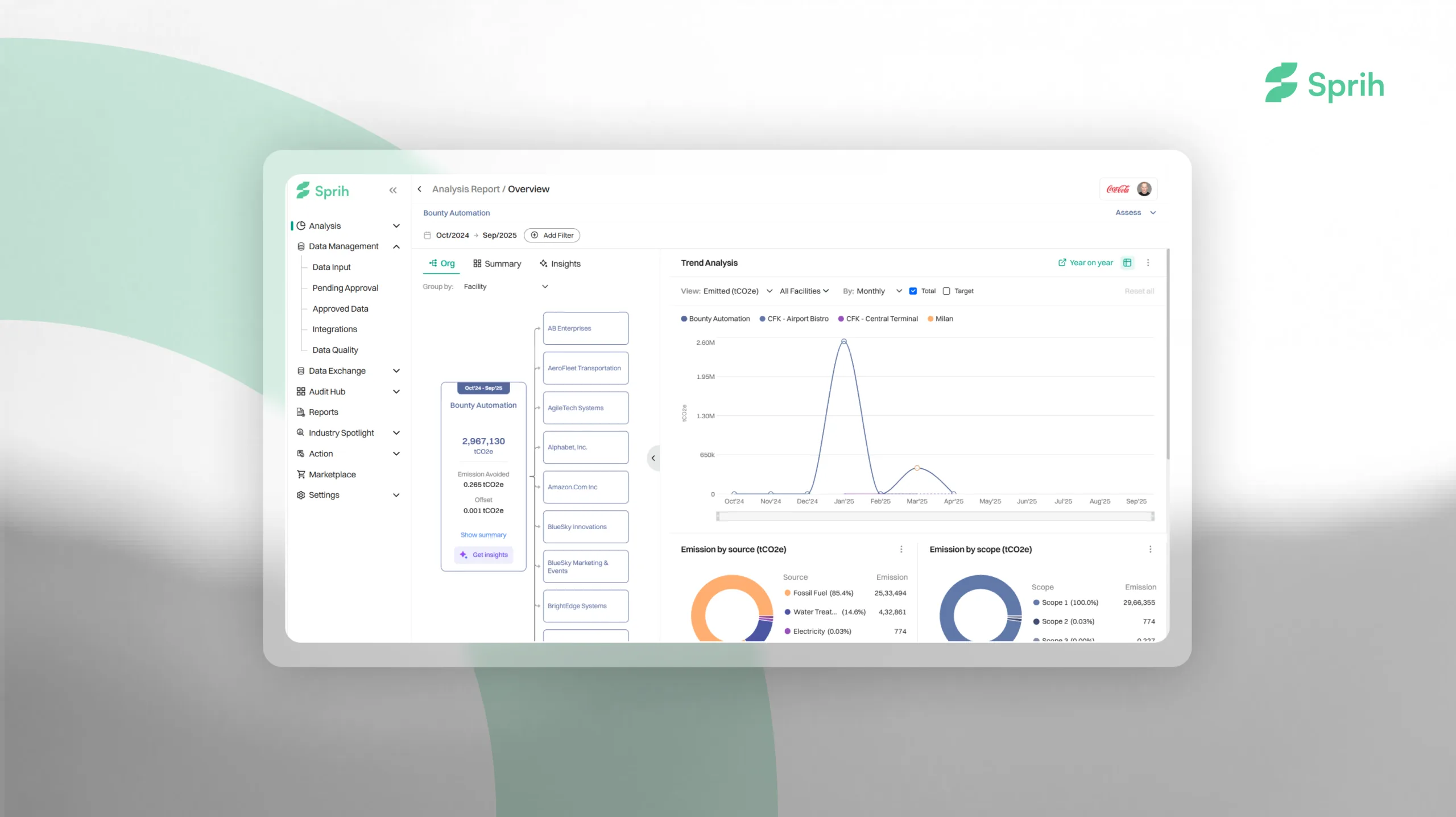
Sprih is an AI-native enterprise sustainability platform designed for companies facing CSRD, BRSR, ISSB, and other regulatory mandates. The platform:
- Handles all scopes: Scope 1, 2, and all 15 Scope 3 categories with supplier engagement automation
- Multi-framework native: Maps a single data model to GRI, TCFD, ISSB, CSRD, BRSR, SB 253 simultaneously
- AI-powered automation: SustainSense AI engine automates data collection, validation, and report generation; ReportSense generates audit-ready reports in minutes
- Audit-ready by design: Full calculation transparency, source traceability, version control, and scope documentation
- Enterprise-grade: Scales to 1,000+ facilities, multi-region, multi-currency, SSO integration, API-ready
- Purpose-built for financial institutions: Includes portfolio emissions (Category 15), financed emissions, and investment scenarios
With Sprih, you don’t choose between completeness and simplicity—you get both.
If you’re in the process of evaluating how to choose sustainability software, Sprih’s AI-native sustainability platform is purpose-built for enterprise complexity — covering Scope 1/2/3, CSRD, BRSR, and supply chain in a single platform. Start with Sprih’s SustainSense AI engine to see how AI-powered automation changes what’s possible for your sustainability team.
Conclusion: Take Time to Choose Right
Choosing an sustainability software platform is one of the most important decisions your sustainability team will make. It affects your ability to meet regulatory requirements, engage suppliers, inform board strategy, and ultimately, drive real emissions reductions.
Don’t rush. Run a proper evaluation. Involve all stakeholders. Test with real data. Talk to customers who’ve implemented. And choose a vendor who understands both the technology and the sustainability fundamentals.
The cost of doing this right (3–6 months of evaluation) is a fraction of the cost of doing it wrong (migrations, retraining, missed compliance deadlines).
For more on how to choose sustainability software, see reviews from Gartner Sustainability Software and G2 Sustainability Software.
See Sprih’s AI-native sustainability platform in action.
Ready to find the right sustainability platform for your enterprise? Sprih is designed for companies tackling CSRD, BRSR, ISSB, and complex multi-scope reporting. Request a personalized walkthrough to see if it’s a fit for your needs.