Over the last decade, the sustainability conversation has grown louder, sharper, and more urgent. Every region has introduced some form of climate disclosure. Most organizations have set targets. Every boardroom has a slide on climate risk.
But behind the reports, dashboards, and commitments, the real transformation rests somewhere far less glamorous: supply chains.
If you follow the day-to-day reality of how organizations collect and validate suppliers’ sustainability data, you’ll see a truth that rarely makes it into keynotes or glossy reports. Supply chain teams are being asked to solve a problem they were never designed to solve alone.
And that gap, between expectations of the apex customers and capability of the suppliers, is at the center of the sustainability slowdown everyone quietly talks about but few openly acknowledge.
Let’s break this down.
Walk into any large organization today and you’ll hear a familiar story, no matter which floor you start on.
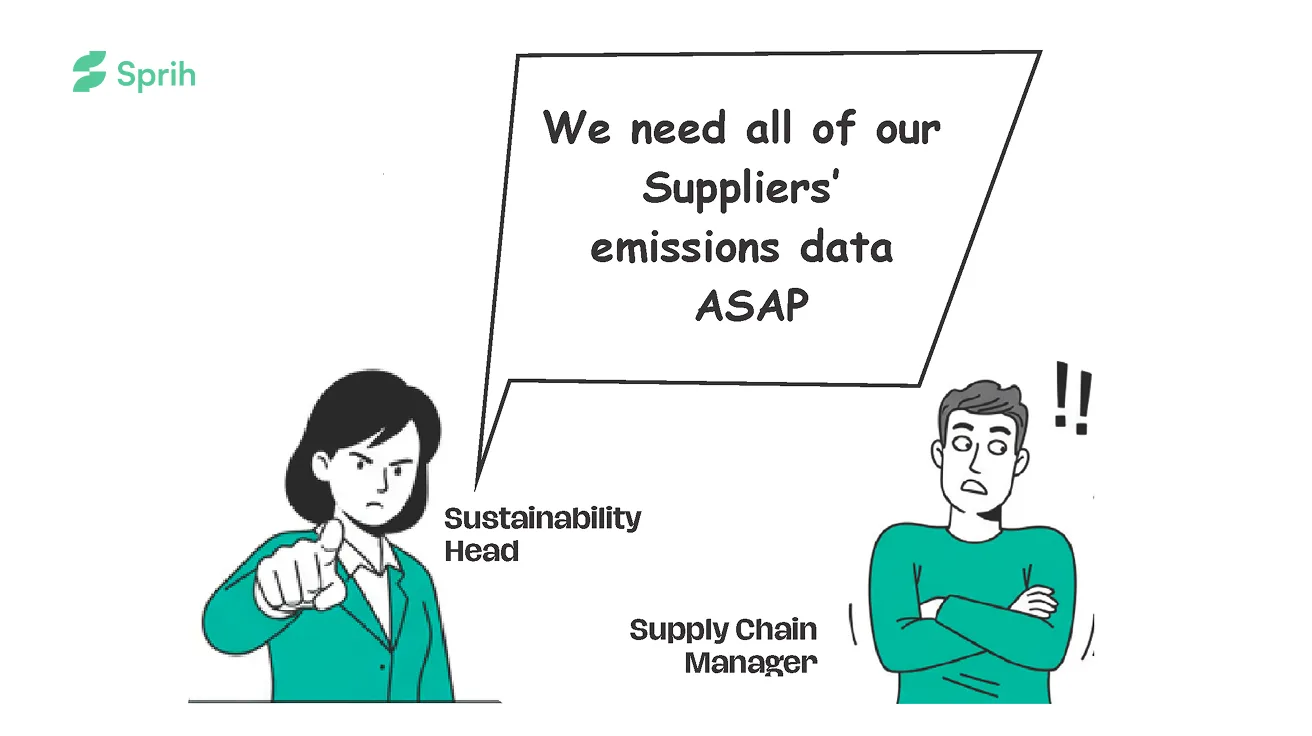
Sustainability teams are under pressure to publish accurate, defensible data. They need supplier-level sustainability data that actually ties back to reality, not a patchwork of estimates. Every reporting cycle tightens the screws. Every new regulation raises the bar. They spend half their time chasing clarity and the other half explaining why the numbers don’t line up.
Procurement is being asked to help, but their KPIs were never built around emissions data. They want suppliers to respond faster, but they also know the requests are piling up.
Compliance teams want audit-ready numbers that hold up under scrutiny.
Leadership wants dashboards that show real progress.
And sitting right in the middle of all of this: supply chain managers.
They’re the ones expected to:
It’s an impossible workload disguised as a workflow.
What makes it even more complicated is how invisible the effort becomes. The burden is spread across dozens of teams, hundreds of emails, and thousands of spreadsheets. Nothing looks broken from the top, yet everything feels strained at the bottom.
That’s where the real tension sits:
we’ve placed global sustainability expectations on functions never designed for environmental accounting.
Sustainability teams feel the pressure of incomplete data.
Supply chain teams feel the pressure of collecting it.
And suppliers feel the pressure of repeating it.
That misalignment is the root of the frustration you hear across the entire value chain, and why the current model can’t scale much further.
Now shift to the supplier side and things look even messier.
Most suppliers today receive requests from multiple customers, all asking for some version of the same information — emissions, energy, water, certifications, initiatives, progress.
The only difference is the format, portal, or spreadsheet.
Some suppliers handle fifty to a hundred sustainability requests a year. Many are asked to fill out:
The duplication is exhausting. The irony is even more striking: everyone says they want high-quality data, yet everyone keeps building new systems that make the process more fragmented.
Suppliers aren’t refusing to share data. They’re refusing to repeat the same work in ten different places.
This is not a data problem.
This is a coordination problem.
If you trace the evolution of sustainability reporting, the story looks linear on paper but far messier in practice.
Regulators did increase pressure, yes. But that’s not the only thing that truly reshaped the system. The real turning point was when companies realized their biggest climate exposure wasn’t inside their own walls, it was in the supply chain.
The moment organizations understood that supplier emissions and supplier practices directly influence their own risk profile, everything changed. Suddenly:
And naturally, companies pushed all of this pressure downstream.
They started demanding more data from suppliers. Not only for compliance, but to protect themselves: their targets, their disclosures, their reputation, and in many cases, their license to operate.
That’s what triggered the explosion of templates, portals, spreadsheets, and submission workflows.
Everyone built their own system.
Everyone asked suppliers for the same information in slightly different ways.
Suppliers complied because they couldn’t risk being seen as unresponsive or unprepared.
But every new request added friction. And that friction multiplied faster than the insight.
We created a landscape where suppliers face disproportionate pressure, often without the tools, resources, or guidance to meet it. Missing a disclosure or delaying a response no longer feels like a minor administrative issue; it feels like a potential risk to customer relationships and future business.
The result is a process that looks structured from the top but feels chaotic at the bottom.
The industry kept chasing more disclosure, not better understanding.
More data points, not more usable insight.
More pressure, not more capability.
That’s how we ended up with a system that strains everyone, and still struggles to produce clarity when we need it most.
At the heart of the problem is fragmentation — not at the edges, but at the core.
Every company asks for a slightly different set of data points.
Every team creates its own template or portal.
Every supplier has a different way of recording operational activity data.
Every auditor brings a different view on what constitutes “sufficient evidence.”
Every customer demands the same information but in a different structure, format, or level of granularity.
And here’s the nuance that matters:
it’s not that suppliers use “different methods.”
Most calculation methods are well-established. The issue is everything before the calculation.
These inconsistencies create gaps long before emissions factors ever enter the picture.
The result is a patchwork of inputs that simply don’t align.
Sustainability teams can’t compare like-for-like.
Procurement teams can’t see progress clearly.
Finance can’t close their books with confidence.
And suppliers end up explaining the same context repeatedly because no two customers consume data the same way.
When the foundation is inconsistent, the output will always be fragile, no matter how sophisticated the calculation engine is.
That’s the fragmentation we’re really fighting.
Every year, a new “data exchange platform” promises to simplify supplier sustainability.
But here’s the uncomfortable truth: the last thing suppliers want is another portal.
They don’t want more spreadsheets.
They don’t want more logins.
They don’t want to re-explain the same process notes to every new customer.
What suppliers want is consistency — a single place where they can share information once, have it understood correctly, and trust that it won’t be misinterpreted downstream.
But suppliers aren’t the only ones under strain.
Apex customers — the large companies driving this entire ecosystem — are under pressure too.
They’re held accountable for Scope 3 accuracy even when the data isn’t in their control.
They’re expected to track supplier maturity, audit evidence, and risk exposure across thousands of vendors.
They juggle inconsistent formats, missing documentation, and year-to-year variations that break every model they build.
They lose months merging, cleaning, and validating inputs.
And when disclosures are published, they’re the ones who carry the reputational and regulatory risk.
So while suppliers drown in requests, apex customers drown in unusable data.
Both sides are struggling, just in different ways.
That’s why the solution can’t be another portal or another version of “upload your file here.”
We don’t need more collection points.
We need shared intelligence.
Imagine a system where:
This isn’t a dream scenario. It’s simply better infrastructure.
A way for suppliers to avoid repetitive work.
A way for apex customers to avoid data chaos.
A way for both sides to stop losing time to processes that don’t add value — and start focusing on the decisions that actually move the climate needle.
That’s the shift the industry is ready for. Not another portal. A smarter operating system for sustainability itself.
If the first decade of sustainability tech was about collecting data, the next decade will be about learning from it.
We’re entering a phase where:
Intelligence, not templates, will decide whether supply chain sustainability becomes manageable or unbearable.
The industry stands at a crossroads.
One path continues the current trend: fragmented tools, repeated data requests, more manual work disguised as “supply chain sustainability program,” and growing frustration on both sides of the value chain.
The other path shifts the entire conversation:
This shift won’t come from adding more questionnaires.
It will come from rethinking how sustainability data flows across supply chains.
The companies that recognise this early will move faster, report better, and build stronger supplier relationships. The ones that don’t will spend the next few years playing catch-up as regulations tighten and expectations climb.
For real progress, we need a mindset shift across the industry.
Supply chain sustainability is at a breaking point, not because people aren’t trying, but because the approach itself is flawed.
We’ve built a system that asks for precision but operates with duplication.
We’ve created expectations without giving teams the tools to meet them.
We’ve overloaded the people who sit closest to suppliers.
If we want meaningful progress, we need to redesign the foundation, not add more layers on top of it.
This next chapter won’t be led by louder targets or stricter templates.
It will be led by clarity, coordination, and intelligence by systems that take the burden away from people and place it where it belongs, in shared, scalable technology.